

Designing an Efficient Loading Bay: What the Specifications Don't Tell You

Most loading bay design guides focus on equipment selection, dock dimensions, traffic flow, and safety systems. While these fundamentals are important, many operational issues only become apparent once the facility is in use.
Having worked with loading bays across manufacturing, logistics, cold storage and distribution environments, we've found that some of the biggest performance, safety and maintenance challenges stem from design details that are often overlooked during the specification stage.
Start with Operational Requirements
Understanding vehicle movements, loading methods, throughput requirements and future growth remains the foundation of good loading bay design. However, the operational reality often differs from the original assumptions, making flexibility critical.
A loading bay designed solely around today's requirements may quickly become a constraint as vehicle types, loading patterns and operational demands evolve.
Dock Bumpers: One Size Does Not Fit All
Dock bumpers are frequently specified as an afterthought, yet selecting the wrong type can create operational and safety issues.
For example, projection-style dock bumpers positioned above dock level may work well where forklift loading is the norm. However, facilities that regularly use pallet trucks can experience difficulties moving products in and out of trailers due to restricted access and uneven transitions between the warehouse floor and vehicle bed.
The correct bumper specification should always be based on:
Vehicle type
Loading equipment used
Dock arrangement
How the trailers are docked – are shunters used?
Trailer suspension characteristics
Dock Leveller Geometry Matters
When specifying a dock leveller, many projects focus on platform size and load capacity while overlooking under-lip clearance.
This becomes particularly important where refrigerated trailers or specialist vehicles with internal steps are used.
If insufficient clearance is allowed beneath the leveller lip, the lip can foul on internal trailer structures during loading operations. This can damage equipment, interrupt operations and present safety risks for forklift operators.
These issues are particularly common with telescopic lip dock levellers if vehicle variations have not been fully considered during specification.
The Hidden Cost of Yard Slopes
A sloping approach road may appear insignificant on a drawing, but it can dramatically affect loading bay performance.
Steep slopes can:
Reduce the effective working range of a dock leveller
Create a trough between trailer and leveller, causing difficulties for pallet truck operations
Increase loading forces on dock bumpers as trailers level during loading
Require taller dock shelters to maintain sealing performance
Increase the risk of trailer door movement and load instability
In many cases, correcting excessive gradients during the design phase is considerably cheaper than managing operational problems for the life of the facility.
Inflatable Shelters Are Not Always the Best Solution
Inflatable dock shelters are often promoted as the premium option for temperature-controlled facilities.
In reality, they do not always provide significantly better thermal performance than a correctly specified collapsible dock shelter.
Air leakage commonly occurs through:
Door hinge areas
Gaps around trailer contours
Interfaces between the shelter and the dock face
Damaged shelter components
The overall loading bay design has a far greater influence on energy performance than shelter type alone.
For many applications, a well-designed collapsible shelter can provide excellent environmental control while reducing maintenance costs and complexity.
Safety Systems Can Introduce Risk
Safety equipment should reduce risk, not simply satisfy a specification checklist.
Unfortunately, some loading bays become over-engineered with poorly considered safety systems that create additional hazards or encourage unsafe operator behaviour.
The most effective safety solutions are those that integrate naturally into the loading process while remaining simple, reliable and easy to understand.
Good design should focus on human behaviour as much as mechanical protection.
Tail Lift Recesses: A Common Design Compromise
Many modern warehouse developments include tail lift recesses primarily to reduce construction costs and improve flexibility during building design.
However, in facilities requiring temperature control, these recesses often become a significant source of energy loss.
The additional openings create pathways for air infiltration and make effective sealing more difficult, reducing overall environmental control within the warehouse.
Where temperature stability is important, the long-term energy costs should be considered alongside the initial construction savings.
High-Speed Doors Are Not Always the Answer
High-speed doors are frequently specified as the default solution for energy efficiency.
While they can reduce airflow compared with conventional doors, their effectiveness depends heavily on usage patterns.
In high-traffic environments where doors are opening continuously throughout the day, temperature loss can still be substantial.
In some applications:
Strip curtains provide a more effective thermal barrier
Air barriers significantly outperform doors alone
A combination of technologies delivers the best results
The correct solution depends on traffic frequency, temperature differential and operational requirements.
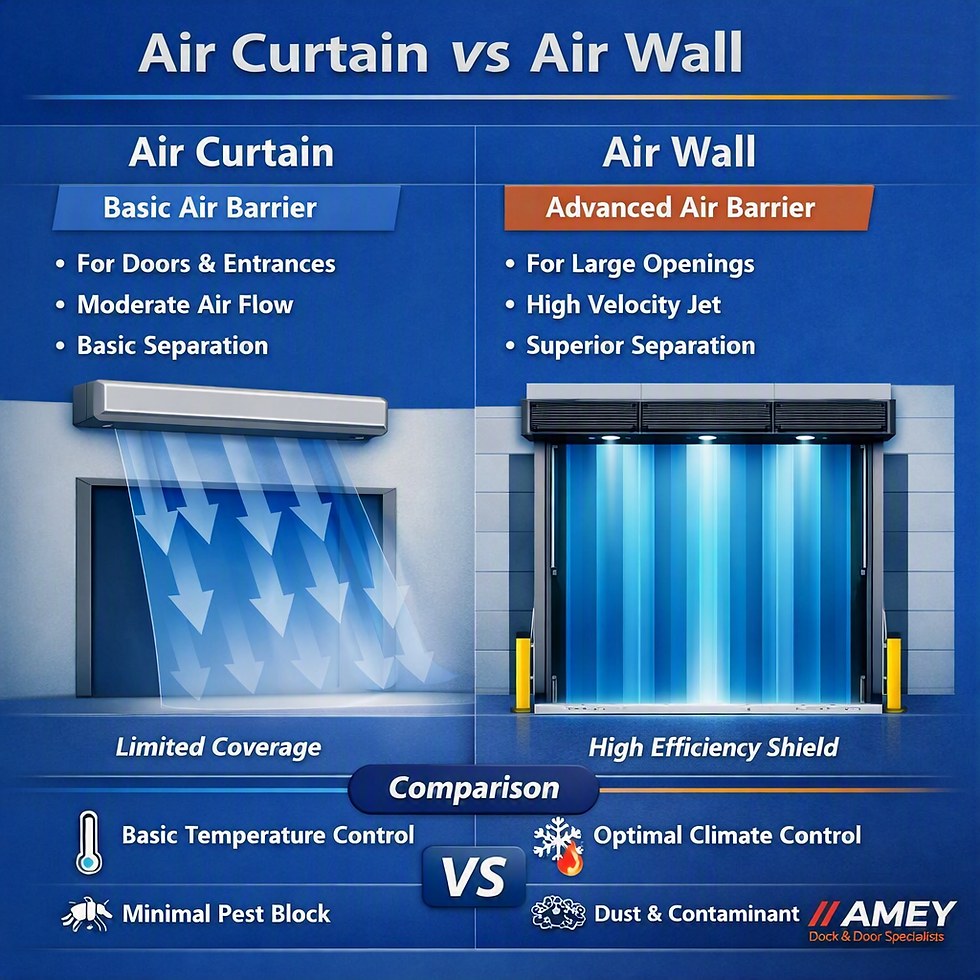
Air Barriers: Often Overlooked, Frequently More Effective
When doorwayss experience large volumes of traffic, air barrier technology can provide greater temperature control benefits than relying solely on fast-action doors.
By creating a continuous separation between internal and external environments, air barriers help reduce infiltration regardless of how often the doorway is used.
For cold storage, food production and temperature-controlled logistics environments, this can result in substantial energy savings while improving operator comfort.
Preventing Damage Starts Outside the Building
Many facilities invest heavily in wheel guides while overlooking simpler measures that can often deliver greater results.
Clear yard markings, well-designed vehicle approaches and effective lighting significantly improve driver positioning and reduce accidental impacts with dock shelters and loading equipment.
In practice, good visibility and guidance frequently prevent more damage than physical wheel guides alone.
Final Thoughts
A successful loading bay is not simply the result of selecting the right dock leveller, shelter or industrial door. It is the outcome of understanding how vehicles, operators, equipment and building infrastructure interact in real-world conditions.
Many of the most expensive loading bay problems arise not from major design failures, but from small specification details that were overlooked during planning.
By considering operational realities such as vehicle variation, yard gradients, thermal performance, loading methods and human behaviour, businesses can create loading bays that are safer, more efficient and significantly cheaper to operate throughout their lifecycle.
Because the most successful loading bays aren't necessarily the ones with the most equipment. They're the ones designed around how people actually use them.

Comments